
Infrared Sauna vs. Traditional Sauna: What's the Difference, and Which Is Better?


If you are looking for a way to relax, unwind, and get some heat, here is the deal - people have been using saunas for centuries. There are two popular options: the traditional Finnish-style saunas and infrared saunas.
Both offer heat exposure, but they accomplish it differently.
If you've been googling infrared sauna benefits, you may have found testimonies about detox, heart health, muscle recovery, inflammation, and even longevity.
But how much of that information is supported by true research? I think we have all found that anyone can make research prove what you want if you cast the right slant. One question I was not asking was: can we assume that the benefits observed with traditional saunas also apply to infrared saunas?
So I thought it would be a great time to look at the differences between the two, infrared sauna vs traditional sauna, and what is the current research telling us, and how do either of these relate to your recovery and wellness goals.
1. How Does a Traditional Sauna Work?
Traditional saunas heat the surrounding air, usually with an electric or wood-burning heater. The heated air then warms your skin and body.
Traditional Finnish saunas commonly operate around 150–195°F (65–90°C). Having used several of these traditional saunas in my younger years, the one memory I have is my notrils literally burning from the hot air when I would step inside, but overall the heat felt good to a body thath had chronic pain.
In some saunas, water may be poured over heated stones to briefly increase humidity and change the sensation of heat.
As your body responds to the hot environment, several physiological changes occur:
Heart rate increases.
Blood vessels near the skin dilate.
Sweating increases to help regulate temperature.
Circulation and cardiovascular demands change.
These responses are part of the body's normal thermoregulatory system. The part of our brain activity that keeps us close to that 98.6 degree F set point.
When exploring infrared sauna vs traditional sauna, we look at the traditional Finnish sauna bathing which also has a substantial history of research, including observational studies examining cardiovascular health and long-term health outcomes.
Note: However, though there are associations between frequent sauna use and better health, the research does not necessarily prove that saunas cause those benefits.
2. How Does an Infrared Sauna Work?
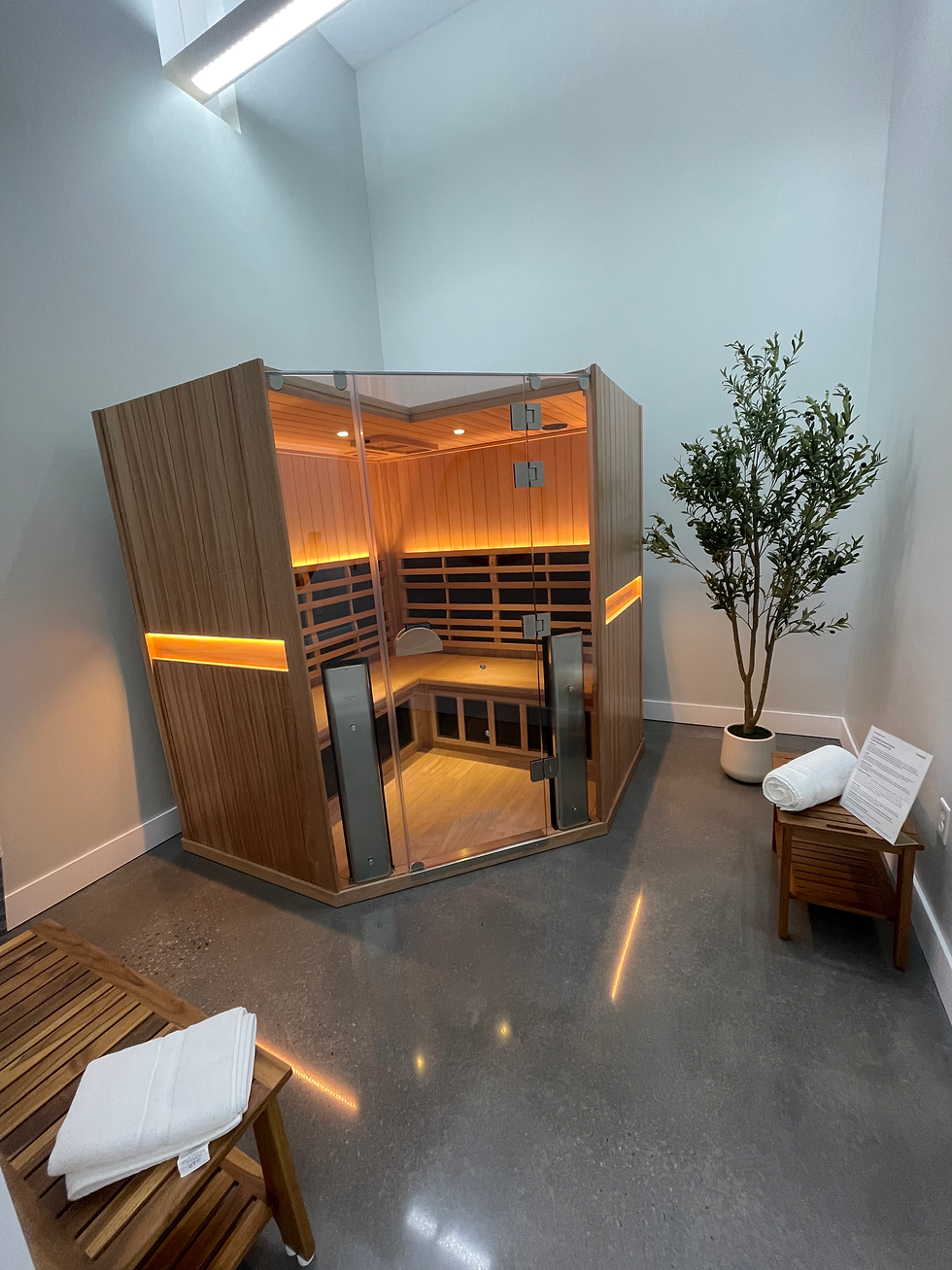
Infrared saunas use infrared-emitting heaters to transfer energy directly to the body and surrounding surfaces rather than relying primarily on very hot air.
Infrared saunas generally operate at lower air temperatures, ours our most often between 125–150°F.
You can still sweat and experience cardiovascular responses to the heat, but the surrounding air is typically less intense than in a traditional sauna.
This may make infrared sauna more comfortable for people who don't appreciate or do well with very high air temperatures.
To be clear, Infrared heat is not the same as the red light used in photobiomodulation treatments. Infrared sauna is primarily a heat-based intervention, while red light therapy uses selected wavelengths and doses for different biological effects.
3. Infrared Sauna vs. Traditional Sauna: Side-by-Side Comparison
Feature | Traditional Sauna | Infrared Sauna |
Heating method | Primarily heats surrounding air | Uses radiant infrared energy |
Typical temperature | 150–195°F | 125-150°F |
Humidity | Usually low; may rise with water on stones | Generally low |
Heat sensation | Hotter surrounding air | Lower air temperature with radiant warmth |
Sweating | Yes | Yes |
Heart rate response | Increases | May increase |
Cardiovascular research | Larger research base | Smaller, developing research base |
Comfort | Preferred by people who enjoy intense heat | May suit people who prefer lower air temperatures |
The key difference is how heat is delivered—not that one sauna automatically produces better health outcomes.
4. Which Sauna Is Better for Cardiovascular Health?
The benefits of traditional Finnish sauna has been the subject of several large observational studies, particularly involving Finnish populations. Some of these studies have found associations between more frequent sauna bathing and lower rates of cardiovascular events and mortality. These findings are encouraging, but observational research cannot establish cause and effect.
Infrared sauna has also been studied for cardiovascular applications, including blood pressure and selected heart conditions. However, many studies are relatively small, and the evidence is not sufficient to assume identical long-term outcomes.
What Does Direct Comparison Research Show?
A 2025 study published in the American Journal of Physiology compared traditional sauna, far-infrared sauna, and hot water immersion in 20 healthy young adults.
Participants completed different passive heat exposures, including traditional sauna at 176°F and far-infrared sauna at 113–149°F.
Under the study conditions, traditional sauna produced a greater increase in core body temperature than far-infrared sauna, while both produced cardiovascular responses.
The study demonstrates why temperature, duration, and type of heat exposure matter.
It also reinforces an important point: Observations from traditional saunas should not be directly applied to infrared saunas.
The best evidence supports evaluating each type of sauna according to its own research and actual exposure conditions.
5. Is One Sauna Better for Muscle Recovery Than Another?
Short answer - No. Athletes frequently use heat as part of their recovery routines.
Heat exposure can increase skin blood flow and may help with relaxation and temporary muscle discomfort.
Some research has explored sauna bathing after exercise, heat acclimation, and potential effects on endurance adaptations.
However, evidence does not establish that either traditional or infrared sauna consistently improves muscle repair or athletic performance after every workout.
For runners and other endurance athletes, sauna exposure may also create additional physiological stress.
That matters when training volume is high, hydration is inadequate, or recovery between sessions is already limited.
Sauna use should complement—not replace—adequate sleep, nutrition, hydration, and appropriate training.
6. Does Infrared Sauna Detoxify the Body?
Quick answer: It is possible. One of the most popular claims about saunas is that they help you sweat out the toxins in your body. Even if your liver is working appropriately and filtering out the toxins, and you have the appropriate enzymes necessary to bind to toxins in order to rid them out of your body, the amount of toxins released in the actual sweat is minimal compared to the amount of toxins that are excreted when you urinate or have a bowel movement. However, with the cardiovascular benefits as mentioned above, increasing heart rate and vasodilation, these physiological benefits are a perfect setup to improve your circulation, which results in an efficient filtering and waste-management system. So, infrared sauna can in fact help to detoxify the body when the liver is working as it should.
7. Can Sauna Use Help With Stress and Relaxation?
Take time away from daily responsibilities and spending time relaxing in the warmth, quiet environment, provides an intentional break from activity. Some people report feeling more relaxed or sleeping better after sauna use. The fact that individuals perceive decreased stress and improved relaxation is what we call an "anecdotal" reason to incorporate sauna into a wellness routine. At Balance by Brooks, we emphasize making recovery a consistent part of life rather than waiting until stress or fatigue becomes overwhelming. Sometimes, just knowing you scheduled your quiet recovery appointment ahead of time helps with the perception of everyday stress.
8. Which Sauna Is Safer?
Both traditional and infrared sauna expose the body to heat stress. Lower air temperature does not mean infrared sauna is automatically risk-free. Potential concerns include: dehydration, dizziness, low blood pressure, overheating, and fainting. Individuals with cardiovascular conditions, blood pressure concerns, pregnancy, certain medical conditions, or medications affecting temperature regulation should seek appropriate medical guidance. For beginners, shorter sessions and gradual exposure are generally more sensible than attempting to tolerate extreme heat. Drink adequate fluids, avoid alcohol, and leave the sauna if you feel dizzy, weak, nauseated, or unwell. More heat is not always better.
9. So, Which Sauna Should You Choose?
The answer depends on your preferences, health considerations, and intended purpose.
A traditional sauna may appeal to you if:
You enjoy very hot air and the traditional Finnish sauna experience.
You prefer the option of adding steam through water on heated stones.
You are particularly interested in the form of sauna bathing studied in much of the long-term Finnish research.
An infrared sauna may appeal to you if:
You prefer a lower surrounding air temperature.
You enjoy radiant heat.
You want a comfortable, scheduled heat-based relaxation experience.
You are looking for a sauna option to incorporate into a broader recovery routine.
Neither option is universally superior.
The best choice is one that is appropriate for your health, comfortable enough to use responsibly, and consistent with your goals.
10. Experience Infrared Sauna Near Greensboro, NC
At Balance by Brooks Recovery & Wellness, located in Summerfield, North Carolina, we offer infrared sauna as one of several recovery and wellness services. Our studio welcomes clients from Summerfield, Greensboro, Oak Ridge, and surrounding communities. Whether you are an endurance athlete, strength-training enthusiast, busy professional, or someone seeking a regular opportunity to relax, our goal is to help you make informed decisions about your recovery. We also offer red light therapy, pneumatic compression, halotherapy, cold plunge, contrast therapy, and personalized wellness guidance.
Recovery does not have to be complicated. It does, however, deserve your attention.
Ready to Experience Infrared Sauna?
Schedule your infrared sauna session at Balance by Brooks Recovery & Wellness.
BOOK YOUR INFRARED SAUNA SESSION
Balance by Brooks Recovery & Wellness
1007 NC Highway 150, Suite B Summerfield, NC 27358
336-298-4288
Frequently Asked Questions
Is infrared sauna better than traditional sauna?
Neither is universally better. Traditional sauna has a larger body of long-term cardiovascular research, while infrared sauna generally operates at lower air temperatures. The appropriate choice depends on individual goals, comfort, and health considerations.
Does infrared sauna make you sweat as much as traditional sauna?
Both can produce sweating, but the amount varies with temperature, duration, humidity, individual physiology, and other factors. More sweating does not necessarily indicate greater health benefits.
Is infrared sauna good for athletes?
Infrared sauna may provide relaxation and a heat-based recovery experience. However, evidence for specific performance and recovery benefits remains limited, and heat exposure adds physiological stress.
Can infrared sauna help with weight loss?
Infrared saunas support fat loss and metabolic health through a process known as exercise mimicry—artificially generating the cardiovascular and hormonal responses of a light workout.
Where can I find infrared sauna near Greensboro, NC?
Balance by Brooks Recovery & Wellness offers infrared sauna appointments in Summerfield, NC, near Greensboro and Oak Ridge.
Research and Further Reading
Mayo Clinic. Do infrared saunas have any health benefits? (2024).
Atencio JK, et al. Comparison of thermoregulatory, cardiovascular, and immune responses to different passive heat therapy modalities. American Journal of Physiology-Regulatory, Integrative and Comparative Physiology. 2025.
Far-infrared saunas for treatment of cardiovascular risk factors: Summary of published evidence. 2009.
Sauna use as a novel management approach for cardiovascular health and peripheral arterial disease. Frontiers in Cardiovascular Medicine. 2025.
This article is for general education and does not replace individualized medical advice.


Comments